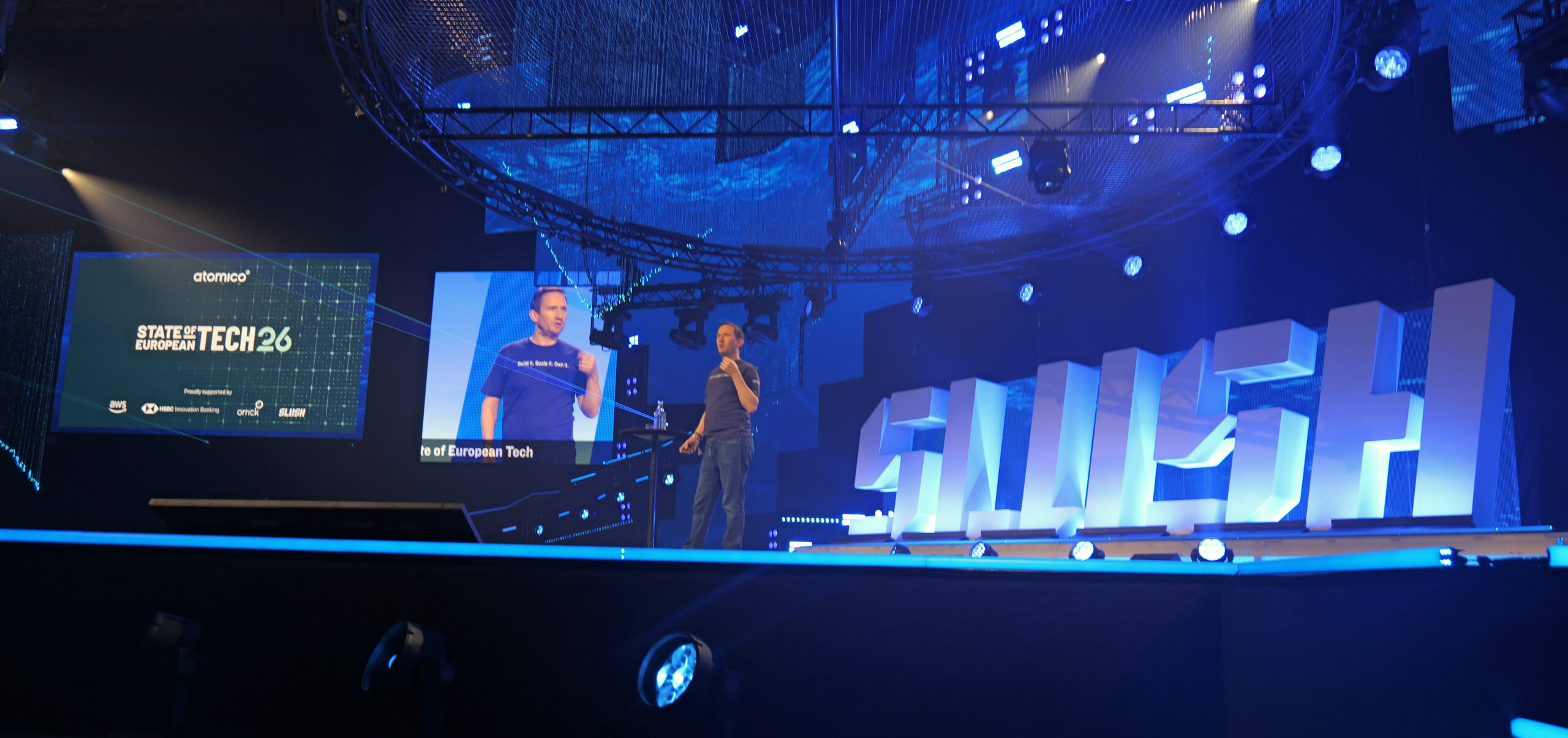
European tech startups are on track to raise $81 billion in 2026, up 62 percent and the second-largest total on record, venture firm Atomico said Wednesday at Slush in Helsinki.
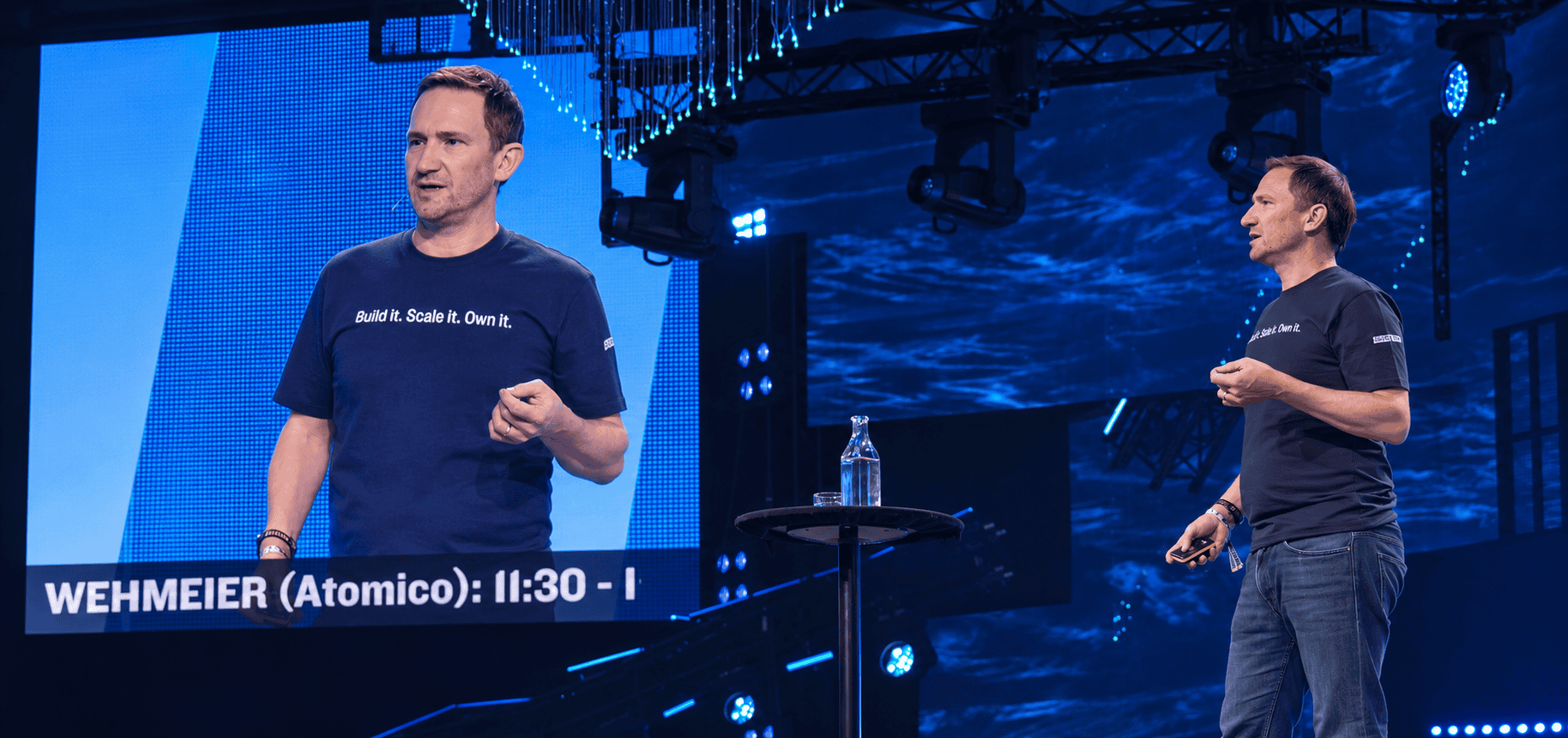
The same report puts Europe’s share of global venture investment at 9.4 percent so far this year, less than half its 20 percent peak in 2022. Tom Wehmeier, a partner and head of intelligence at the London-headquartered firm, presented the State of European Tech 2026 on the Founder Stage in a 15-minute keynote built on the report’s tagline: build it, scale it, own it. He treated building as the part Europe has demonstrated, and scaling and ownership as the parts that still need conviction and capital.
The report is a venture investor’s account of its own market, and it says so. Atomico compiled it with data from Dealroom.co, PitchBook, S&P Global Market Intelligence and others, ran its survey with Listen Labs, and published it with support from Amazon Web Services, HSBC Innovation Banking, Orrick and Slush. On several slides it also notes when a highlighted company sits in Atomico’s portfolio. Its central policy request, moving more pension and insurance money into venture funds, would enlarge the pool that firms like Atomico raise from, a point readers should weigh alongside the data. The report does not disclose how many founders, investors and policymakers answered its survey, so the survey percentages below show how each group split without showing how large each group was.
Founder numbers hit a decade high
About 40,000 people started a tech company in Europe in 2026, according to the report, up 36 percent on 2025 and 80 percent on 2024, the highest level in the past decade. Both recent years are forecasts, adjusted for reporting lag and extrapolated from data through Sept. 30. Europe produced 29 percent of the world’s new tech founders, narrowly ahead of the United States at 28 percent, though the report cautions that Chinese founders are likely undercounted in its data.
Founders who start out in Europe are also staying put, Wehmeier told the audience. Among European-origin founders whose previous job was in Europe, 92 percent started their companies there in 2026, up from 86 percent in 2017. The pattern runs the other way for Europeans already working in the United States, where 70 percent of that group now build, up from 57 percent.
Alumni networks keep the pipeline full. The report counts 24,000 “first-generation” founders who once worked at a venture-backed European company valued at $1 billion or above, and another 19,000 who came out of companies those founders started. Fifty-eight European companies reached a $1 billion valuation in the first nine months of 2026, against 42 in all of 2025, lifting the running count to 466. Fifty-three now carry valuations of $10 billion or above. Seven are worth $100 billion or above, up from one in 2017.
Lovable, the Stockholm vibe-coding company, is the report’s showcase for speed. It announced $100 million in annual recurring revenue in July 2025, eight months after reporting $1 million, and Lovable said no company had reached that mark faster at the time. Eleven months later it reported annual recurring revenue above $500 million, according to the company’s own figures as the report relays them. Wehmeier cited the climb as evidence that nothing fundamental stops a company from scaling quickly out of Europe.
Capital returns, but concentrates at the top
That speed now has money behind it, though the headline figure needs its footnotes, because the $81 billion projection extends nine months of data to a full year and excludes pharma, debt, lending capital and grants. It would end three years stuck between $40 billion and $50 billion and trail only 2021’s record $94 billion. Atomico’s figures also change between editions, since last year’s put 2025 on track for about $44 billion while this year’s puts 2025 at $50 billion.
Much of the jump sits in a handful of deals. Thirteen rounds of $1 billion or above closed in the first nine months, the most Europe has recorded, raising $22 billion between them, or 37 percent of all capital invested. The five largest recipients took 23 percent of the year’s funding, compared with about 6 percent in 2022. At the other end, the number of “first money in” rounds before Series A fell almost 30 percent between 2021 and 2025.
Not every voice in the report reads that concentration as health. Sara Rywe, a partner at ByFounders, saw the drop in first rounds as the market settling after the 2021 and 2022 frenzy but said rising round sizes and valuations feel like “heading straight back into bubble territory.” Investors in the survey share some of that unease. Among investor and limited partner respondents who gave a view, 47 percent called top-tier AI valuations inflated across the board and expected a gradual correction. Another 28 percent saw the inflation limited to a handful of rounds, and 21 percent expected a sharp correction.
The growth also looks smaller beside the United States, the comparison behind the halved global share. U.S. startups drew $450 billion through Sept. 30, 7.4 times Europe’s total for the same period. The report attributes Europe’s slide to money pooling in AI companies, especially U.S.-based ones. Wehmeier’s answer from the stage was that, given equal funding, European founders keep pace with U.S. peers in creating value, so the gap lies in capital rather than talent.
The report backs that argument with Dealroom data, labeled illustrative, showing European and U.S. companies that raised similar sums reaching $1 billion valuations at similar rates. In a quote printed in the report, Wehmeier said Europe’s founders are “flying into the wind,” a condition he said still works but caps top speed.
Who owns what Europe builds
If capital is the constraint, the report’s next question is where Europe’s own money sits. European households held over $50 trillion in financial assets at the end of 2024, the report says. Citing the European Central Bank, it puts 33 percent of Europeans’ financial assets in cash and bank deposits, against 11 percent for U.S. households. From 2022 to 2025, European pension funds committed an average 0.006 percent of their assets to venture capital each year, against 0.028 percent for U.S. funds. European insurers committed 0.005 percent, against 0.017 percent for U.S. insurers, a U.S. figure the report bases on 2022 alone.
Foreign investors fill the gap. Over a third of European rounds (36 percent) now include at least one investor from outside Europe backing the company for the first time, and at Series C the share is 76 percent, up from 31 percent in 2017. By Atomico’s estimate, which splits each round equally among its investors, U.S. investors supplied 52 percent of Series C capital in European rounds from 2024 through September 2026. That is double their 26 percent share in 2017 to 2019.
Exits, where investors are paid, remain thin by Europe’s own past standard. By the report’s measure, which counts announced as well as completed acquisitions for 2025 and 2026, European exit value so far in 2026 stands at $74 billion, below the 10-year average of $103 billion. Only seven European tech IPOs took place through Oct. 20. Wise shifted its main listing from London to Nasdaq in May, and Bending Spoons went public on Nasdaq in July at an $18 billion valuation, by the report’s count.
Acquisitions show who is buying. Atomico counts 10 announced or completed acquisitions of venture-backed European tech companies at $1 billion or above in 2025 and 2026 to date and says U.S. companies made six of them. Wehmeier told the audience that building companies others own completes only half the job, and that Europe should hold the biggest stake in what it builds. One deal the report names needs a caveat: it lists Uber’s agreement to buy the Berlin chauffeur service Blacklane at $1.1 billion, but Uber’s quarterly filing with the U.S. Securities and Exchange Commission says the company completed the purchase on Aug. 13, 2026, for a total price of $554 million in cash, below the threshold the tally uses.
Compute, defense and the data layer
Capital is one dependency, and the infrastructure under Europe’s software is another that sits closer to the systems security, privacy and discovery teams manage. Measured by cumulative AI chip arrivals from 2022 through the second quarter of 2026, counted in H100 equivalents, the report puts the United States at just over 72 percent of global compute capacity and Europe at about 7 percent. It notes that arrivals show where chips land, not who owns or runs them. EU industrial electricity costs end users 151 euros per megawatt-hour, the most recent figure in data from the EU Agency for the Cooperation of Energy Regulators that the report cites, which it says is over double the U.S. price.
Investment is moving toward those layers. Compute and intelligence companies drew $20 billion in the first nine months, up from $9.5 billion in all of 2025, and nearly half of it went to Nscale and Mistral. Defense tech set a record at $7.2 billion, driven by megarounds for Helsing, STARK and Quantum Systems. Atomico folded cybersecurity into its defense category this year, reasoning that cyber threats now figure in hybrid warfare and state security. Wehmeier noted that four of the five European defense tech companies that have raised the most money began in universities.
Public buyers have yet to follow the investors. The report reviewed nearly 9,500 public tech contract award notices since 2024 that name a vendor or product, covering contracts above EU thresholds in the EU, the European Economic Area and Switzerland. Of those, 82 percent name a U.S. vendor and 19 percent a European one, and the shares overlap because a notice can name several vendors. Among the 18 most frequently named vendors, SAP is the lone European one, and innovation procurement has stayed near 9 percent of public procurement since 2021 against a 20 percent EU target.
For records and eDiscovery teams, those figures suggest how often European public-sector technology relies on U.S. vendors and products, an inference from the procurement counts rather than a finding the report states. The notices record which vendors or products are named, not who signed each contract or on what terms, so teams can test the pattern against their own vendor and preservation registers. Citing Gartner, the report puts European spending on sovereign cloud infrastructure as a service at about $35 billion across 2026 and 2027, and that is the market where the pattern could shift.
EU Inc stalls where founders want it most
Founders, asked what would help most, point at legal plumbing rather than hardware. Fifty percent of founder respondents chose EU Inc, which the survey describes as a single company form that works across Europe, among up to three policy changes that would most help them. Better tax treatment of stock options followed at 42 percent. Wehmeier told the audience the proposal is under negotiation and that the only outcome that counts is a company form founders actually adopt.
The legislation has not reached that point. The European Commission proposed EU Inc as an EU-wide company form on March 18, 2026, and the Council of the EU adopted its negotiating position on Oct. 23. The Council text would allow fast-track online registration with a 48-hour decision deadline that excludes weekends and public holidays, and fees capped at 100 euros, according to an analysis by Irish law firm Matheson. It would also let member states delay or refuse registration on money-laundering, terrorist-financing or other criminal grounds, so for compliance teams the speed would come with screening built into registration rather than removed from it.
Parliament is the holdup. Talks can begin only after it adopts its own position, and its Legal Affairs Committee has not voted on rapporteur René Repasi’s draft report. A vote planned for Oct. 8 was postponed after the lead negotiators could not agree on employee participation, and one planned for Oct. 19 did not take place either. On Nov. 11 the negotiators failed for the third time since early October to settle those provisions, and a committee vote expected Nov. 16 was postponed again, Agence Europe reported. Repasi told the news site Rapporteur that the goal the Commission, Council and Parliament had set of finishing talks by the end of this year can no longer be met.
Outside the committee room, unions warn that companies could use the form to sidestep worker protections, while the EU-INC founder campaign argues the proposal has drifted from the version it backed. Euronews has reported that the campaign’s backers include figures associated with Atomico.
Survey sentiment helps explain founders’ impatience. About two-thirds of founder respondents describe Europe’s regulatory environment as restrictive, slightly below last year. Policymakers who answered the survey went further, with 82 percent saying Europe needs radical change to compete and most of that group saying it can be delivered with enough political will.
Public trust trails the sector’s value
Political will, in turn, depends on voters who are not yet convinced. In Atomico’s tally of an Ipsos survey of 11 European countries in March and April 2026, which leaves out respondents who did not know, 27 percent expected AI to improve their national economy over the next three to five years. Another 39 percent expected no change, and about a third expected it to get worse. The report offers one reason the sector’s value is hard for the public to see: newer champions sell to businesses and governments rather than households. Of the European-origin $1 billion companies founded from 2010 to 2014, 46 percent sell mainly to consumers, against 24 percent of those founded since 2015.
Wehmeier’s prescription was to show what tech changes in daily life, from lower energy bills to earlier diagnoses, and to let European savings and pensions share in the upside. European tech has value to share by Atomico’s count. It puts the whole sector at $4.4 trillion, with the latest trillion added in under two years, and Europe’s venture-backed companies at $3.3 trillion. That equals 16 percent of the STOXX Europe 600’s $20.5 trillion value, a comparison of the companies’ enterprise value with the index’s market value.
A year ago, Wehmeier told the same stage that Europe stood at a crossroads. This year’s founder count suggests Europe’s builders have picked a direction. The 9.4 percent global share shows how far the money lags, and the 76 percent share of Series C rounds that add a new backer from outside Europe shows who is filling the gap. For the professionals who will secure, govern and eventually collect the data these companies generate, the question is practical: when Europe’s next champion runs on capital, compute and contracts sourced elsewhere, whose rules will govern its records?
News sources
- A Call for Control of Frontier AI Models (Office of the President of the Republic of Finland)
- President Stubb and Prime Minister of Norway: The rapid development of AI requires international cooperation (Office of the President of the Republic of Finland)
- Slush | About Us (Slush)
- Noora Saksa appointed as new Slush CEO (Slush)
- Alexander Stubb (Slush)
- Google Deepens Commitment to Finland with Two-Year €13 Billion investment in AI Infrastructure (Google)
- A Coordinated Implementation Roadmap for the Transition to Post-Quantum Cryptography (European Commission and NIS Cooperation Group)
- Digital Omnibus on AI (Future of Life Institute, EU AI Act Explorer)
- Critical and strategic raw materials (Geological Survey of Finland)
- Energy production (Finnish Energy)
- Interim Report for Q3 2026 (IQM Quantum Computers via GlobeNewswire)
- How many quantum computers have been sold? (The Quantum Insider)
- Finland’s Stubb Cautiously Optimistic on Ukraine Peace Talks (Bloomberg)
- Finland’s Data Center Tally Tops €67 Billion on AI Boom (Bloomberg)
- Presidentti Stubb: Mitä enemmän datakeskuksia, sen parempi: “Enemmän on enemmän” (Yle)
- ICEYE Launches €2.05B Takeover Bid for Italian Rocket Builder Avio (European Spaceflight)
- ICEYE bids to acquire Vega-C rocket maker Avio (AeroTime)
- Finland orders halt to work on Google’s data center sites (AFP via Courthouse News)
- Police open preliminary probe into Google’s data centre site activities in Muhos (Yle)
- Finland launches criminal probe of suspected environmental damage by Google (Al Jazeera)
- EXCLUSIVE: Google bets $15B on Finland as nation’s president explains why (Fox News Digital)
- Finland and Norway lead 22-nation call for global AI oversight body, as US and China stay out (FAIR EDIH)
- Finland’s NestAI lands €100M, partners with Nokia to build AI for defense applications (TechCrunch)
- Ukrainian Flamingo maker eyes anti-ballistic air defense by 2027 (The Kyiv Independent)
- Slush 2026 (The Recursive)
- EU AI Act Update: Digital Omnibus Finalizes 8 Compliance Changes (Orrick)
- EU Commission Roadmap Targets 2030 for Post-Quantum Cryptography Transition (PostQuantum.com)
- Slush 2026 brings a smaller, sharper bet on European startups to Helsinki (ComplexDiscovery)
Assisted by GAI and LLM Technologies
Source: HaystackID shared with permission of ComplexDiscovery OÜ
Advisory Note: A kill switch mandate may apply only to the largest AI providers, but organizations that build on those providers’ models would also be affected by a shutdown. To prepare, an organization needs to know where it uses AI, which systems depend on third-party models, and how it would document, contain, and recover from a disruption. HaystackID’s AI Governance Services help organizations inventory and classify AI systems, implement governance programs aligned with recognized frameworks, test high-risk systems for security and fairness, and report to executives and boards. HaystackID builds governance into daily operations and produces documentation that regulators, customers, and other stakeholders can review. Organizations evaluating their AI risk can connect with HaystackID’s team of experts to learn more.